
Korean Combi Blinds Singapore: The Dual-Layer Blind That Does It All (And Why Everyone's Getting Them)
TL;DR
Korean combi blinds — also known as rainbow blinds or zebra blinds — use a double-layer fabric system that lets you switch between filtered light and privacy without changing blinds.
The mechanism works at any height you set it to, giving you light control that is genuinely continuous rather than just open-or-closed.
Available in blackout fabric (up to ~90% darkening due to the combi mechanism structure) or dim-out fabric (70–90% light dimming depending on fabric and colour choice).
Their rising popularity in Singapore is closely linked to the global rise of K-culture — these blinds originated from Korean interior design trends.
softhome offers combi blinds in both manual and motorised systems, with motorisation powered by Somfy (Google Assistant and Alexa compatible).
Described by softhome as "the epitome of roller blinds" — and once you understand the mechanism, it's easy to see why.
—
Walk into any Singapore home that was renovated in the last few years, and there's a reasonable chance you'll spot them — a blind with a distinctive alternating pattern of solid and sheer horizontal bands, sitting cleanly against the window frame. Pull the cord, and the bands shift. The room changes. Light filters in. Or it doesn't. It's up to you, at any position, at any time.
These are combi blinds. And if you've been hearing the names "Korean blinds," "rainbow blinds," or "zebra blinds" thrown around in renovation forums, HDB Facebook groups, or interior design Instagram accounts — they're all the same thing.
The question most people eventually ask is: what exactly makes them different from a regular roller blind? And is the hype justified for Singapore homes?
This guide answers both — grounded entirely in what softhome offers and knows about this product.
What Are Korean Combi Blinds, Exactly?
Korean combi blinds are described by softhome as the epitome of roller blinds. That's a bold claim — so let's unpack what actually makes them special.
A standard roller blind is a single sheet of fabric. It goes up or it goes down. When it's down, it blocks or filters light based on whichever fabric type you chose. That's it. The only variable is how far you've lowered it.
A combi blind operates on an entirely different principle. It uses a double-layer fabric system — two layers of material with alternating bands of solid (opaque) fabric and sheer (translucent or open-weave) fabric. The two layers move independently, and by sliding them relative to each other, you create different light conditions.
When the solid bands of each layer align, they block light — giving you privacy and shade. When they offset, the sheer sections line up, and soft, filtered light flows through. The elegant part: this transition happens at whatever height you've set the blind to. You're not choosing between "blind up" or "blind down." You're choosing the quality of light at every position, continuously.
This is what the name "combi" refers to — a combination of both filtering and blocking within a single blind, in a single fluid mechanism.
The alternative names tell you about its character: rainbow blind for the layered, banded visual effect; zebra blind for the alternating stripe pattern the two fabric layers create.
Where Korean Combi Blinds Come From — and Why Singapore Loves Them
softhome notes that combi blinds have been gaining popularity, likely driven by the rise of K-culture — the global wave of Korean cultural influence that has reshaped everything from music and food to fashion and interior design.
Korean interiors have long prioritised a clean, layered approach to light and privacy. The combi blind is a direct product of that sensibility — a window treatment designed not just to cover a window, but to give the occupant precise, intuitive control over the relationship between inside and outside. It looks considered. It feels modern. And it works with the minimalist, white-wall aesthetic that dominates contemporary Singapore HDB and condo interiors.
Beyond the aesthetic trend, there's a practical reality: Singapore homeowners renovating their homes are increasingly research-driven. They browse Pinterest, watch renovation videos, follow interior design accounts, and arrive at their interior design consultation having already formed preferences. Combi blinds show up consistently in this research landscape — and once you understand how they work, they're difficult to un-see.
Learn more about combi blinds here.
The Two Fabric Options: Blackout vs Dim-Out
Like softhome's roller blinds, combi blinds are available in two fabric types. Choosing correctly here has a significant impact on how your blind performs.
Blackout Combi Blinds
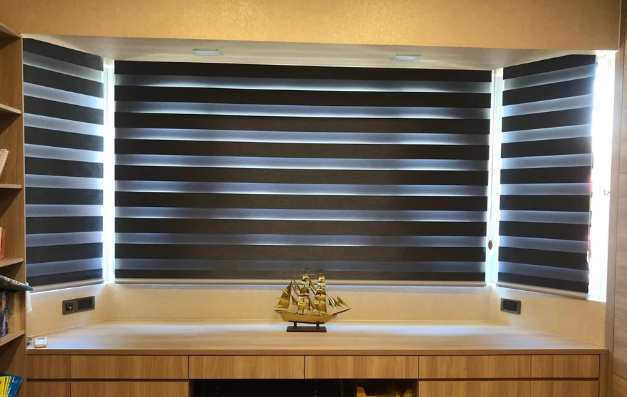
Blackout fabric in a combi blind is 100% opaque — the fabric itself blocks all light. However, it's important to understand a nuance specific to the combi mechanism: because of the structure and construction of how the double-layer system works, the best achievable darkening in a blackout combi blind is approximately 90%, rather than the full 100% you'd get from a standard blackout roller blind.
This is not a flaw — it's a mechanical reality of the combi blind design. The two fabric layers and the way they interact at the edges and transitions mean some minimal light can still enter even when the solid bands are fully aligned. For most rooms and most purposes, approximately 90% darkening is more than sufficient. For applications requiring absolute, total blackout (professional media rooms, shift-worker bedrooms), a standard blackout roller blind remains the more appropriate choice.
For everything else — bedrooms, living rooms, home offices — blackout combi blinds deliver excellent light control with the added versatility of the combi mechanism.
Dim-Out Combi Blinds
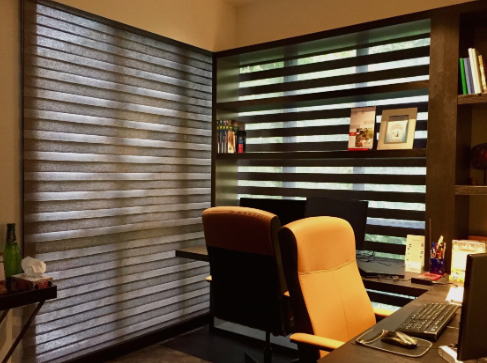
Dim-out combi blinds provide 70–90% light dimming, with the exact level varying based on fabric choice and colour selection. Darker colours within the dim-out range will sit toward the higher end of light reduction; lighter colours toward the lower end.
Dim-out combi blinds are suited to spaces where some natural light is welcome even in the "closed" position — living rooms during the day, home offices, dining areas. The sheer bands, when offset, add an additional layer of soft, filtered light that makes the dim-out combi blind particularly pleasant to live with.
A practical note on colour: lighter-coloured dim-out fabrics will allow more light transmission even when solid bands are aligned, while darker fabrics will dim more effectively. This is worth considering when selecting your fabric colour — especially for east-facing rooms that catch morning sun or west-facing rooms with intense afternoon exposure.
Why Combi Blinds Work Particularly Well in Singapore
Singapore's window treatment challenge is well-established: intense tropical sun, the need for privacy in high-density housing, a desire for natural light without glare, and interiors that need to transition smoothly between daytime and evening use.
Standard roller blinds handle this with a binary approach — the blind is down or it isn't. Combi blinds handle it with genuine nuance.
In the morning, you can set the blind at mid-height with bands offset to let in soft, filtered daylight without direct sun penetration. The sheer bands scatter the light, making it pleasant rather than harsh.
In the afternoon, when Singapore sun is at its most aggressive, you can align the solid bands fully to block direct sunlight while keeping the blind at any height that suits the room.
In the evening, when privacy from street-level or neighbouring units matters more than light control, the solid bands close completely — providing the privacy of a standard blind without sacrificing the aesthetic of the combi mechanism.
For west-facing windows — notoriously difficult in Singapore condos — combi blinds offer a meaningful advantage over sheers or standard rollers. You get active light management without losing the clean, uncluttered look that open sheers provide.
For HDB living rooms with neighbours directly across the corridor, the combi blind's ability to provide daytime privacy while still admitting natural light is particularly practical. Standard sheer curtains provide light but minimal privacy. Combi blinds in dim-out fabric can provide both simultaneously.
Motorised Korean Combi Blinds: Smart Home Integration
For homeowners building out a smart home setup — or simply those who want the convenience of not manually adjusting blinds across multiple windows daily — softhome offers motorised combi blinds powered by Somfy.
Somfy is a French motor brand recognised globally as the benchmark for motorised blind and shutter reliability. The motorised system for combi blinds includes:
Remote control operation
Smartphone app control via iOS and Android through Somfy's dedicated app
Voice control integration via Google Assistant or Amazon Alexa, through the Somfy TaHoma Beecon hub
For combi blinds specifically, motorisation adds a layer of practical value that goes beyond convenience. The combi mechanism requires you to manage not just the height of the blind but the alignment of the two fabric layers — and doing this across multiple windows manually, multiple times a day, adds up. A motorised system makes that seamless.
For living rooms with large windows or multiple windows side-by-side, motorised combi blinds that synchronise across all panels create a unified, effortless light management experience that manual systems struggle to replicate at scale.
Interested in motorised combi blinds?Book a consultation with softhome to see the motorised system demonstrated and get advice on whether it suits your window configuration.
Combi Blinds vs Other Blind Types: Where They Sit
It helps to understand how Korean combi blinds compare to the other roller blind options available through softhome — not to declare a winner, but to clarify which is the right tool for which job.
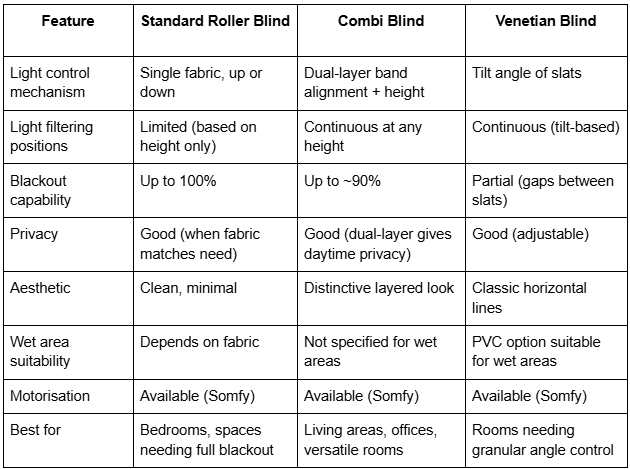
The combi blind sits in a particularly strong position for living rooms, dining areas, and home offices — spaces that need to transition across multiple light conditions throughout the day without requiring manual intervention every time.
Practical Buying Tips for Korean Combi Blinds
Understand the ~90% blackout limit before choosing. If your primary goal is total, absolute darkness — for example, a shift-worker's bedroom or a dedicated home cinema room — a standard blackout roller blind will outperform a blackout combi blind at that specific task. For everything else, the ~90% darkening of a blackout combi blind is highly effective.
Factor in fabric colour for dim-out options. The 70–90% light dimming range in dim-out combi blinds is influenced by the colour you choose. Darker fabrics dim more; lighter fabrics let more light through. If maximum dimming within the dim-out range is important to you, lean toward deeper tones.
Consider how many windows you're outfitting. For a single window, manual combi blinds work perfectly well. For living rooms with three or four windows, or open-plan spaces where you want consistent light management across the entire room, motorised combi blinds become significantly more practical.
Think about sun direction. West-facing windows in Singapore get the harshest afternoon sun. For these, combi blinds in blackout fabric give you the ability to block direct sun while still looking elegant — a better solution than heavy drapes or standard blackout rollers, which can make a room feel closed-in even when partially raised.
Match the blind to the room's daytime function. Combi blinds are at their best in rooms that are actively used during daylight hours — where you want to manage light continuously rather than set it once and leave. For rooms that are only used at night (a spare bedroom, for instance), a simpler roller blind may serve just as well at lower cost.
Ready to explore the options? View softhome's combi blind range and book a measure and quote appointment to find the right fabric, colour, and system for your space.
Frequently Asked Questions
What are Korean combi blinds?
Korean combi blinds — also called rainbow blinds or zebra blinds — are a type of roller blind that uses a double-layer fabric system with alternating solid and sheer horizontal bands. By shifting the two layers relative to each other, you can transition between filtered light and privacy at any height the blind is set to. They are described by softhome as the epitome of roller blinds for their versatility.
Why are they called Korean blinds?
The combi blind originated from Korean interior design and has gained global popularity alongside the broader rise of K-culture. The design reflects Korean interiors' emphasis on clean aesthetics and nuanced light control. In Singapore, they are commonly referred to as Korean blinds, though rainbow blinds and zebra blinds are also widely used names for the same product.
What is the difference between blackout and dim-out combi blinds?
Blackout combi blinds use 100% opaque fabric, achieving approximately 90% darkening of a space — the ~10% gap is a result of the combi mechanism's double-layer structure rather than the fabric itself. Dim-out combi blinds provide 70–90% light dimming depending on the fabric and colour chosen. Blackout suits bedrooms and spaces needing strong light blocking; dim-out suits living areas and offices where some natural light is welcome.
Can combi blinds achieve 100% blackout?
No. Due to the structure and mechanism of the combi blind, even blackout-fabric combi blinds achieve approximately 90% darkening rather than full 100% blackout. If complete, total darkness is the primary requirement, a standard blackout roller blind is a more suitable choice.
Are Korean combi blinds available in motorised versions?
Yes. softhome offers motorised combi blinds powered by Somfy, a French motor brand. Motorised combi blinds can be controlled via remote, smartphone app (iOS and Android), and voice through Google Assistant or Amazon Alexa via the Somfy TaHoma Beecon hub.
How is a combi blind different from a regular roller blind?
A standard roller blind is a single sheet of fabric — it either covers or exposes the window, with light control determined only by how far it is lowered. A combi blind uses two layers of alternating solid and sheer fabric bands. By shifting these layers, you can filter light, block light, or combine both effects at any blind position. This gives continuous, nuanced light control that a single-layer roller blind cannot provide.
Are combi blinds suitable for all rooms?
Combi blinds work best in rooms that are actively used during daylight hours and where varying light conditions are needed throughout the day — living rooms, dining areas, home offices, and bedrooms. For rooms primarily used at night, or where absolute blackout is the sole priority, a standard roller blind may be equally effective. They are not specifically indicated for wet areas like bathrooms — for those, softhome's PVC venetian blinds or perforated roller blinds are more appropriate.
What is the light dimming range for dim-out combi blinds?
Dim-out combi blinds provide between 70% and 90% light dimming, depending on the specific fabric and colour selected. Darker colours achieve greater dimming; lighter colours allow more light through even when solid bands are aligned.
