
Balcony Ziptrak® Blinds Singapore: The Weather-Proof Outdoor Blind Built to Handle Our Climate
TL;DR
Ziptrak® blinds are the most popular track-guided outdoor blind system in Australia — engineered to keep out rain, dust, heat, insects, and UV from balconies and semi-outdoor spaces.
The patented spring-balanced system means the blind can be pushed up or pulled down with one hand, stopping at any height with no cords, wire cables, or clumsy zippers.
PanoView® technology allows a single Ziptrak® blind to span up to 6 metres wide and 4.7 metres tall — delivering an unobstructed view without posts or split panels breaking it up.
Wind-load testing shows Ziptrak® PanoView® blinds withstanding static loads equivalent to 260km/h winds (TÜV SÜD tested), with Sunshade blinds tested at 130km/h (University of Adelaide).
The PestOut® Pelmet with brush insert keeps flying insects out — no more mosquitoes, moths, or uninvited guests sharing your balcony.
Motorisation is available via Somfy or Dooya, with smartphone, Google Assistant, and Alexa compatibility — controllable with one hand, one finger, or one voice.
—
Every Singapore homeowner with a balcony knows the frustration. You designed it to be an extension of your living space. A place to have morning coffee, let the kids play, host a dinner, or simply sit and breathe. And then Singapore's weather does what it always does — delivers a sudden 4pm downpour, or a 34-degree afternoon that makes stepping outside feel like opening an oven door.
The result? Balconies that are only truly usable for a few hours a week. Outdoor furniture that weathers faster than it should. Floors and walls perpetually streaked with rain. And a beautiful view you're watching from behind glass rather than living in.
Ziptrak® blinds exist to solve exactly this. Not by walling your balcony off permanently — but by giving you a weather-proof, insect-proof, UV-protected barrier that you control, at any height, at any time, with minimal effort. When conditions are good, the blind retracts cleanly out of sight. When the sky turns grey or the afternoon sun hits at full intensity, you deploy it — one hand, seconds, done.
This guide covers everything a Singapore homeowner needs to know about Ziptrak® balcony blinds: what makes the system genuinely different, what the technical specifications actually mean in practice, and what to know before booking a consultation.
What Is Ziptrak® and What Makes It Different?
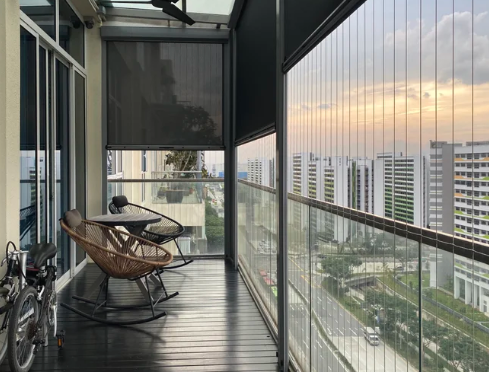
Ziptrak® is an Australian-engineered, patented outdoor blind system. In Australia — where outdoor living culture is arguably more demanding than anywhere — it is the most popular track-guided blind system on the market. That context matters: the design has been refined in a market where outdoor blinds are genuinely used hard, across extreme conditions, by discerning homeowners.
Three patented features define the Ziptrak® system and separate it from conventional outdoor blinds:
1. The Spring-Balanced System
This is the mechanism that makes Ziptrak® distinctively easy to use. A spring-balanced system means the blind is counterbalanced — so lifting or lowering it requires minimal force, regardless of the blind's size. You push it up or pull it down with one hand. It stops at any height. No wrestling with heavy fabric, no cord systems to manage, no awkward cranking mechanisms.
For homeowners with larger balconies where a single blind might be 3 or 4 metres wide — or where the blind is tall — this ease of operation isn't a luxury, it's what makes the system actually usable day-to-day. Conventional outdoor blinds at that scale are genuinely difficult to operate repeatedly.
A pull-stick is provided for heights that are out of comfortable reach.
2. The Patented Cordera Spline — The Only Zipless Track-Guided System
Most track-guided outdoor blinds use a zip or zipper to keep the fabric secured within the track. Ziptrak® does not. The Cordera Spline is a patented technology that is high-frequency welded to the front and back of the fabric — it runs along the side edges of the blind and sits inside the track, holding the blind secure without a zip.
Why does this matter? Two reasons:
Durability: Zippers wear out. The Cordera Spline is structural — it's welded into the fabric, making it the toughest edge-securing system in the market. The fabric also stays flat along the spline, so you won't see wrinkles or creases along the edges when the blind is fully lowered.
Finishing: Without a zip running down the visible face of the blind, the aesthetic is cleaner. There are no zip teeth to see, no zip pull to catch on, no zip to jam in Singapore's dusty, humid outdoor conditions.
3. The Locking Mechanism
When the blind is fully lowered, Ziptrak® locks into place. This is particularly important in Singapore where afternoon thunderstorms can arrive with significant wind. A blind that rattles, flaps, or lifts in wind is both annoying and potentially damaging. Ziptrak® is designed to remain secure and rattle-free even in windy conditions.
To unlock, press the unique Centre Lock Release — and both the left and right locks release simultaneously with a single action.
What Balcony Ziptrak® Blinds Actually Protect Against
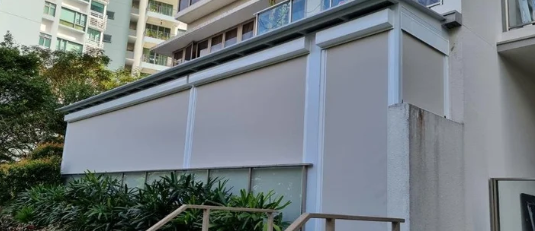
The protection Ziptrak® provides to a Singapore balcony is comprehensive. From softhome's summary:
Rain — A closed Ziptrak® blind creates a barrier against rain, keeping your balcony floor, furniture, and walls dry during Singapore's frequent downpours. You can keep the blind partially open at an intermediate height to maintain airflow while still deflecting most rain.
Sun and Glare — The blind shields UV and reduces glare from direct sun exposure. For west-facing balconies in particular — where afternoon sun is most intense — this transforms the usability of the space during hours that would otherwise be uncomfortably bright and hot.
Dust — Ziptrak® keeps out most dust, which is relevant for balconies on higher floors or near major roads.
Flying Insects — This is where the PestOut® Pelmet comes in. The pelmet sits at the top of the blind system and includes a unique brush insert that seals the gap between the blind head and the ceiling or beam above. This prevents insects — mosquitoes, moths, and others — from entering the gap at the top of the blind when it is deployed. As softhome puts it: so they do not build a nest in your Nest.
Heat and Energy Costs — By shielding the balcony and the glass doors or windows behind it from direct solar radiation, Ziptrak® blinds reduce heat ingress into your home. This translates directly into lower air conditioning load — keeping your indoor spaces cooler with less energy consumption.
UV — Extended UV exposure damages outdoor furniture, flooring, and fabrics significantly faster than most homeowners expect. Ziptrak® fabric blocks UV, extending the lifespan of everything in and around your balcony.
Explore more about balcony Ziptrack blinds here.
The Wind-Load Testing: Why "Tested to Be Strong" Is Not Marketing Speak
This is where Ziptrak® makes a claim that is verifiable rather than vague: its wind-load performance has been independently tested and published.
In tests conducted by TÜV SÜD — one of the world's leading technical testing organisations — a 2-metre wide by 2-metre high Ziptrak® PanoView® blind was shown to withstand static wind loads equivalent to wind speeds of 260km/h. This is not a field test; it is a controlled structural load test that demonstrates the system's robustness under extreme conditions.
In separate wind loading tests performed by the University of Adelaide, a 2.5-metre wide by 2.5-metre high Ziptrak® Sunshade blind withstood winds of 130km/h.
Singapore's weather, even during severe thunderstorms, does not come close to these tested limits. The practical implication for Singapore homeowners is simple: a properly installed Ziptrak® blind will not rattle, lift, or fail in any weather condition you are likely to encounter here.
PanoView®: One Blind, No Posts, No Interruptions
Traditional outdoor blinds are constrained by the width their mechanism can support — typically around 2.5 metres. For balconies wider than this, the conventional solution is multiple panels with structural posts between them, breaking up the view.
Ziptrak® PanoView® eliminates this constraint. The system supports blinds up to 6 metres wide and 4.7 metres tall — even at significant height above ground. A single PanoView® blind can cover a large balcony opening with no posts, no visual interruption, no panels breaking your sightline.
For Singapore condo and HDB homeowners with a view worth protecting — whether it's a reservoir, a green corridor, a city skyline, or even just the pleasant mid-floor perspective many Singapore homes enjoy — the ability to retain that view as a single uninterrupted frame is significant. PanoView® makes it possible.
Fits Most Shapes — Including Non-Standard Balconies
Singapore balconies are not all rectangular. HDB maisonettes, older condo designs, and some newer developments feature balconies with L-shapes, U-shapes, curved profiles, or angled openings. softhome has installed Ziptrak® blinds across a wide range of atypical configurations including:
Wall-to-wall installations covering the full balcony opening
L-shaped balconies with corner turns
U-shaped balconies wrapping around a corner
Curved balconies with a radius profile
Semi-circle shapes
Double-volume HDB maisonettes with tall, two-storey-height openings
This flexibility comes from the Ziptrak® system's engineering and softhome's experience with non-standard site conditions. If your balcony isn't a simple rectangle, it is worth raising at consultation rather than assuming Ziptrak® won't work — it very likely can.
Keeping Cold Air In: What to Expect
One of the most common questions Singapore homeowners ask about Ziptrak® blinds is whether they can help contain cool air-conditioned air on the balcony or in a room adjacent to an open balcony.
The honest answer: Ziptrak® can be very effective at retaining cold air, but should not be expected to achieve a fully sealed, air-conditioned room.
The effectiveness depends on fabric type. Porous, open-weave fabrics allow air to pass through and will lose cold air more easily — estimated up to 40% air loss. Non-porous fabrics do not allow air to pass through the fabric surface and will be significantly more effective at retaining cool air within the area.
For homeowners hoping to air-condition a balcony space and keep it cool, non-porous fabric selection is the key variable. This is worth discussing specifically at consultation to ensure the right fabric type is matched to your use case.
Manual vs Motorised: One Hand, One Finger, or One Voice
Every Ziptrak® system at softhome is available in manual or motorised operation. The manual system — using the spring-balanced mechanism — is already exceptionally easy to use, operable with one hand at any position. For most installations with one to three blinds, manual operation is practical and sufficient.
Motorised Ziptrak® blinds are powered by Somfy or Dooya motors:
Somfy — The French benchmark for motorised blind reliability, with smartphone app control (iOS and Android), and Google Assistant / Alexa voice integration via the Somfy TaHoma Beecon hub.
Dooya — An alternative motorisation option for those wanting smart control without the Somfy ecosystem.
Motorisation becomes significantly more valuable when you have multiple blinds across a large or complex balcony configuration. Being able to raise and lower four or five blinds simultaneously with a single button press — or a voice command — is qualitatively different from operating each one manually in sequence.
The softhome team summarises it neatly: One hand, one finger, or one voice. Manual, remote, or voice — the choice is yours.
Not sure whether manual or motorised is right for your setup?Read softhome's dedicated guide on Ziptrak® Manual vs Motorised orbook a consultation to talk it through with the team.
Ziptrak® Installation: What to Expect
Knowing the installation timeline helps with renovation planning. From softhome's guidance:
1 to 3 blinds (typical single balcony): 1 full day, 9am to 5pm
4 to 5 blinds: 1 to 2 days
2 balconies or 6+ blinds: 2 to 3 days
Installation is subject to good weather — an important practical note given Singapore's climate. softhome will coordinate scheduling with this in mind.
Two important sequencing notes for renovation planning:
If you are installing invisible grilles, these must be installed before Ziptrak® blinds. Measurements for the blind are taken after the grilles are in place, not before — because the grille structure affects the available installation space and the blind's operating clearance.
If you are in a condo or managed property, check with your Managing Agent (MA) or MCST before proceeding. Some MCSTs specify the types of blinds allowed on balconies and the permissible colours. Confirming this before ordering avoids complications.
Maintenance: What Ziptrak® Needs From You
One of Ziptrak®'s genuine selling points is that it is, by design, maintenance-free for smooth operation. The spring-balanced mechanism and Cordera Spline system do not require regular servicing.
The one exception: in very dusty environments or seafront locations — where salt air and particulate matter are more pronounced — adding lubricant to the tracks once a year helps maintain smooth operation. The lubricant must be a non-oil-based silicone spray. softhome recommends "WD-40® Specialist High Performance Silicone Lubricant" or "WD-40® Specialist® Dirt & Dust Resistant Dry Lube PTFE Spray."
One product to be very aware of: the standard blue-and-yellow WD-40® Multi-Use Product must NOT be used. It is oil-based and will damage the spline tape and clog dust inside the track. This is a common mistake that is worth flagging clearly.
Practical Tips Before You Buy
Check your MCST rules first if you're in a condo. Some developments have specific requirements around blind types, colours, or installation methods for balconies. Getting clarity early avoids delays or the need to reverse decisions.
Install invisible grilles before your Ziptrak® consultation, not after. Grilles change the available installation space and must be in place for accurate measurement.
Think about fabric type relative to your goals. If cold-air retention matters to you, non-porous fabric is significantly more effective. If maximum natural ventilation while blocking rain is the priority, an open-weave fabric may suit better. This is one of the most important fabric decisions to discuss at consultation.
Consider PanoView® if your balcony is wider than 2.5 metres. The ability to span up to 6 metres in a single blind — without posts — preserves your view in a way that multiple narrow panels cannot.
For multiple blinds, take motorisation seriously. The cost-benefit of motorisation increases with the number of blinds. Manually operating four or five blinds across a large balcony multiple times a day quickly becomes tedious. Motorisation turns that into a single button press.
Ready to transform your balcony?Book a consultation with softhome for a site assessment, measurement, and personalised recommendation on fabric type, width, and motorisation.
Frequently Asked Questions
What is Ziptrak® and how does it work?
Ziptrak® is a patented, Australian-engineered, track-guided outdoor blind system. It uses a spring-balanced mechanism that allows the blind to be pushed up or pulled down with one hand, stopping at any height. A patented Cordera Spline — high-frequency welded to the fabric edges — runs inside the track, eliminating the need for zippers or wire cables. When fully lowered, a Centre Lock Release mechanism locks the blind securely in place even in windy conditions.
What does Ziptrak® protect against on a Singapore balcony?
Ziptrak® blinds protect against rain, direct sun and glare, most dust, flying insects (via the PestOut® Pelmet brush insert), and UV radiation. They also reduce heat ingress, which can lower air conditioning energy consumption for indoor spaces adjacent to the balcony.
How wide can Ziptrak® blinds go?
With PanoView® technology, a single Ziptrak® blind can span up to 6 metres wide and 4.7 metres tall — including at height on upper floors. Traditional outdoor blind systems are typically limited to around 2.5 metres wide, requiring multiple panels and posts for larger openings.
How strong are Ziptrak® blinds in wind?
TÜV SÜD-tested Ziptrak® PanoView® blinds (2m x 2m) have withstood static wind loads equivalent to 260km/h wind speeds. University of Adelaide tests on Ziptrak® Sunshade blinds (2.5m x 2.5m) demonstrated resistance to 130km/h winds. The patented side spline and locking mechanism prevent rattling even in strong wind conditions typical of Singapore thunderstorms.
Can I install Ziptrak® blinds on my condo balcony?
Yes, but you should first check with your Managing Agent (MA) or MCST. Some condominiums specify what types of blinds are allowed on balconies and which colours are permitted. Confirming approval before proceeding avoids complications.
Should I install Ziptrak® blinds before or after invisible grilles?
Always install invisible grilles first, then have Ziptrak® measurements taken. The grille structure affects the available space and operating clearance for the blind. Installing in the wrong order means measurements will be inaccurate.
How long does Ziptrak® installation take?
For a typical balcony with 1 to 3 blinds, installation takes 1 full day (9am to 5pm). For 4 to 5 blinds, allow 1 to 2 days. For spaces with 2 balconies or 6 or more blinds, plan for 2 to 3 days. Installation is subject to good weather.
Does Ziptrak® require maintenance?
Ziptrak® is designed to be maintenance-free for smooth operation. In very dusty or seafront environments, applying a non-oil-based silicone spray to the tracks once a year is recommended. The standard WD-40® Multi-Use (blue and yellow) product must NOT be used — it is oil-based and will damage the spline tape.
Can Ziptrak® help keep cold air inside?
Ziptrak® can be effective at retaining cool air, but it is not a sealed system. Non-porous fabrics are significantly better at retaining cold air than open-weave fabrics, which allow estimated air loss of up to 40%. If cold-air retention is a priority, fabric selection matters and should be discussed at consultation.
Is motorised Ziptrak® available, and how does it work?
Yes. softhome offers motorised Ziptrak® blinds powered by Somfy or Dooya motors. Motorised systems can be operated via remote control, smartphone app (iOS and Android), and voice commands through Google Assistant or Amazon Alexa via the Somfy TaHoma Beecon hub. Motorisation is particularly practical for large balconies with multiple blind panels.
