
TL;DR
softhome's roller blinds come in over 180 designs, textures, patterns, and prints across three fabric types: blackout, dim-out, and perforated
Blackout roller blinds block 100% of light and 100% UV — the go-to choice for bedrooms, home theatres, and any room with direct sun exposure
Dim-out roller blinds balance privacy with natural light — made from 100% polyester, but only suitable for dry areas (they absorb water)
Perforated roller blinds have regulated micro-gaps that allow partial sunlight and airflow — water resistant and ideal for spaces with display screens or wet environments
softhome's robust mechanism supports wide roller blinds up to 3 metres (or 3.2m depending on height) without sagging — a common problem with conventional systems
Somfy motorisation is available — control your roller blinds via smartphone, schedule them, or use voice commands through Google Assistant or Amazon Alexa
Available in white or black system (head-rail, pulley cord, and bottom bar)
—
There's a reason roller blinds remain one of the most popular window treatment choices in Singapore. They're practical, space-efficient, easy to operate, and — when you have over 180 designs to choose from — far more stylish than their reputation might suggest.
But not all roller blinds are the same. The wrong fabric type in the wrong room creates real problems: a dim-out blind in a bedroom that doesn't get dark enough, a non-water-resistant blind in a bathroom that warps within months, or a conventional system that sags visibly across a wide window.
Singapore homeowners face a specific set of challenges when choosing window treatments — intense tropical sun, high humidity, privacy in dense residential buildings, and increasingly, the desire to integrate window coverings into a smart home setup. Roller blinds, done right, address all of these. Done wrong, they're a frustrating and costly mistake.
This guide covers everything you need to know about roller blinds in Singapore — the three fabric types, where each works best, what to watch out for, and how softhome's approach to customisation and quality makes a difference.
What Are Roller Blinds? A Clear Definition
Roller blinds are simple, practical window coverings that roll up or down along a single tube mechanism to control light and privacy. The fabric is attached to a roller at the top of the window frame and can be lowered or raised manually (via a cord or chain) or automatically (via a motorised system).
Their appeal lies in their simplicity. Unlike curtains, roller blinds take up minimal space when raised — the fabric rolls neatly into the head-rail, leaving the window completely unobstructed. Unlike venetian or venetian-style blinds, there are no horizontal slats to collect dust or clean individually.
softhome describes roller blinds as "versatile, easy to use and maintain" and highlights their "durable mechanism and material" as core selling points — which is consistent with why they remain a go-to choice across residential and commercial spaces in Singapore.
The Three Fabric Types: Blackout, Dim-Out & Perforated
The most important decision when choosing a roller blind is not the colour or the pattern — it's the fabric type. Each of softhome's three roller blind fabrics behaves differently with light, heat, and moisture, making each one suited to specific rooms and use cases.
Blackout Roller Blinds: Total Light Control
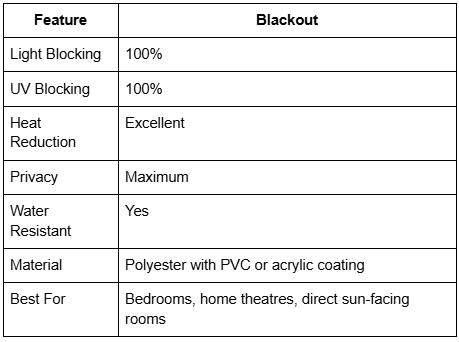
Blackout roller blinds are the most performance-focused of the three fabric types. When fully lowered, they block 100% of light — and critically in Singapore's context, they also block 100% UV radiation from the sun.
Beyond light elimination, blackout roller blinds actively cut down excessive heat from the sun during the day. For rooms with direct sun exposure — particularly west-facing rooms in the brutal afternoon heat or east-facing rooms baking by 8am — this heat reduction is not a minor comfort benefit. It's a genuine thermal management function that reduces the load on air conditioning and makes rooms measurably more comfortable.
softhome also positions blackout as "the go-to option if you are looking for maximum privacy" — a relevant consideration in Singapore's high-density residential environment where windows often face other units, corridors, or external walkways.
What blackout roller blinds are made of
Generally a mixture of polyester with PVC or acrylic coating. The coating is what delivers the 100% light-blocking and UV-blocking performance. These blinds are water resistant, making them suitable for a wider range of environments.
Blackout Roller Blinds at a Glance
Best Rooms for Blackout Roller Blinds
Bedrooms — The clearest application. Blackout roller blinds are the standard recommendation for any bedroom in Singapore, particularly those facing east or west. They allow you to control your wake time independently of the sun — critical for shift workers, parents of young children, and anyone who simply values sleeping past 6:30am.
Home Theatres and Entertainment Rooms — Screen visibility depends on ambient light levels. Blackout roller blinds eliminate glare and reflection that reduce picture quality, creating a dedicated cinema environment without permanent structural changes.
Rooms with Direct Sun Exposure — West-facing living rooms, glass-heavy study spaces, and sun-drenched dining areas that overheat by afternoon all benefit from the heat-cutting properties of a blackout roller blind — even if total darkness isn't the goal for the entire day.
Dim-Out Roller Blinds: Privacy with Daylight
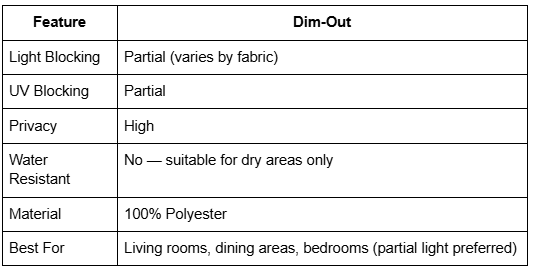
Dim-out roller blinds sit between a sheer curtain and a full blackout in terms of light control. They provide meaningful privacy while still allowing natural daylight to filter into the room — the amount of light admitted varies depending on the specific fabric chosen.
This makes dim-out roller blinds a strong choice for any space where you want to reduce the intensity of direct sunlight and maintain privacy without fully closing off the room from daylight. It's the middle-ground solution for homeowners who find full blackout too cave-like for everyday living spaces.
What dim-out roller blinds are made of
Generally 100% polyester. Importantly, this material absorbs water — which means dim-out roller blinds are only suitable for dry areas. They should not be installed in bathrooms, outdoor-facing wet areas, or any space with regular moisture or condensation exposure.
Dim-Out Roller Blinds at a Glance
Best Rooms for Dim-Out Roller Blinds
Living Rooms and Dining Areas — Spaces where natural light is part of the ambience but harsh glare is unwanted. Dim-out roller blinds reduce intensity without eliminating the sense of connection to the outside.
Bedrooms (for those who prefer some light) — Not everyone wants complete darkness in the morning. For lighter sleepers or early risers, dim-out provides privacy and temperature benefit without sealing the room in full darkness.
Home Offices — Enough daylight to stay energised and alert, but filtered to reduce screen glare and direct heat. A practical choice for study rooms or work-from-home setups.
Perforated Roller Blinds: Airflow, Views & Wet Areas
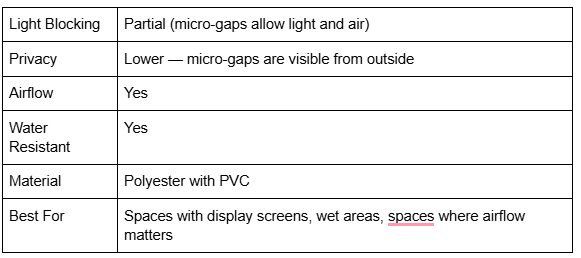
Perforated roller blinds are the most distinctive of softhome's three fabric types. They feature regulated micro-gaps in the fabric that allow partial sunlight and air to pass through even when the blind is fully lowered. This makes them fundamentally different in character from the other two types — they're not designed for privacy or darkness, but for maintaining a connection with the outside while moderating light and heat.
softhome describes perforated blinds as ideal for "spaces that do not require as much privacy" — and highlights a specific use case: complementing important displays. In rooms where a screen or display is the focal point, perforated blinds reduce ambient glare while maintaining the soft, ambient quality of natural light. This is a nuanced application — but one that matters in showrooms, meeting rooms, or home offices where screen visibility is critical.
Perforated fabrics are also highlighted as suitable for wet environments — an important practical distinction from dim-out fabrics. Their PVC content makes them water resistant, opening up applications in bathrooms, laundry areas, or any window position exposed to moisture.
What perforated roller blinds are made of
Generally a mixture of polyester with PVC. Water resistant.
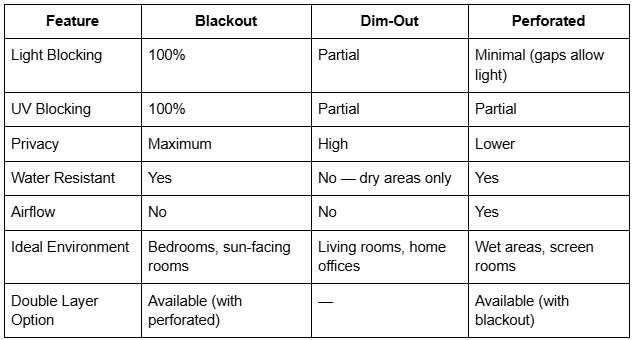
Double Layer Option: softhome also offers a double-layer configuration that combines a perforated fabric with a blackout fabric on the same mechanism — giving you the flexibility of a view-through perforated blind when you want it, and full blackout when you need it. This is a particularly clever solution for rooms where requirements shift throughout the day.
Perforated Roller Blinds at a Glance
Explore all types of roller blinds by softhome!
Blackout vs Dim-Out vs Perforated: The Full Comparison
Why Roller Blinds Work So Well in Singapore
Singapore's physical environment puts specific demands on window treatments that roller blinds are particularly well-equipped to meet.
Heat and direct sun exposure. Singapore sits just one degree north of the equator. The sun is intense, the angle is steep, and — unlike temperate countries — there is no winter reprieve. Blackout roller blinds with their PVC or acrylic coating actively reflect and cut solar heat, reducing the thermal load in sun-facing rooms. This is a genuine energy efficiency benefit, not just a comfort one.
High-density living and privacy. HDB blocks, condominiums, and executive apartments in Singapore are built close together. Windows frequently face other units, corridor walkways, or shared outdoor spaces. Roller blinds — particularly blackout — provide immediate, full-width privacy coverage with a clean, minimal profile that doesn't intrude on interior space.
Humidity and wet environments. Singapore's year-round humidity creates moisture challenges for window treatments. Blackout and perforated roller blinds are both water resistant — making them suitable for bathrooms, laundry rooms, and any window position that sees regular condensation or moisture. Dim-out blinds, being 100% polyester without a water-resistant coating, should be reserved for dry interior spaces only.
Wide windows. Open-plan living is increasingly common in Singapore's newer residential developments — and wide windows come with it. Standard roller blind systems struggle with wide installations, sagging noticeably across the middle. softhome's robust mechanism addresses this directly.
Wide Roller Blinds: softhome's Solution to the Sagging Problem
One of the more practical details that separates softhome's roller blinds from conventional alternatives is the ability to handle wide installations without sagging.
softhome's mechanism supports roller blinds up to 3 metres wide (or up to 3.2 metres wide depending on the height of the blind) — without the deflection in the middle that plagues most standard systems. Sagging in a wide roller blind is not just an aesthetic issue: it affects how evenly the blind lowers, how consistently it blocks light across the full width, and how well it maintains its form over time.
For open-plan living areas, wide glass panels, or any window configuration that exceeds what a standard system can handle cleanly, softhome's mechanism is a meaningful upgrade.
White System or Black System: Choosing Your Hardware Finish
softhome's roller blinds come in two hardware finish options — White System (the default) and Black System.
The system includes the head-rail, pulley cord, and bottom bar — the visible hardware elements of the blind installation. Choosing the right finish matters more than it might initially seem: a white system on a dark wall reads as a contrast element, while a black system on a lighter interior can anchor the window treatment and give it a more deliberate, architectural look.
White suits bright, neutral, and Scandinavian-influenced interiors. Black suits darker, moodier, or more industrial aesthetics and is increasingly popular in contemporary Singapore homes that favour contrast and intentionality in their detailing.
Somfy Motorised Roller Blinds: The Smart Home Upgrade
For homeowners integrating window treatments into a smart home setup, softhome offers Somfy motorisation as an add-on for roller blinds.
Somfy is a French-engineered motorisation system — softhome describes it as "the most reliable and respected brand" in the category. With Somfy motorised roller blinds, you can:
Control your blinds via smartphone or tablet — compatible with iOS and Android through a dedicated app
Set automated schedules — raise blackout blinds at a set time each morning, lower them at a set time each evening
Use voice control — via Google Assistant or Amazon Alexa, using the Somfy TaHoma Beecon as the integration hub
softhome provides configuration guides for both Google Assistant and Alexa linkage, making the setup process accessible for homeowners who aren't technically inclined.
For wide roller blinds in particular, motorisation eliminates the need to manually pull a cord across a large expanse of fabric — a practical convenience that compounds over time. For layered setups — for instance, a perforated blind paired with a blackout blind on a double mechanism — motorisation makes switching between modes genuinely effortless.
Thinking about motorised roller blinds for your home?Book a consultation with softhome to discuss your setup and get a measure and quote.
Over 180 Designs: Choosing the Right Look
softhome's roller blind catalogue spans over 180 designs, textures, patterns, and prints — which is a genuinely broad selection. This range is relevant because the visual quality of a roller blind matters as much as its functional performance. A blackout blind in a bedroom doesn't need to look industrial or clinical. A dim-out blind in a living room should complement the furniture and palette, not fight against it.
The 180+ designs span the full range from clean, solid neutrals to textured weaves, subtle patterns, and printed options — across all three fabric types. Whether your interior tends towards minimalist, Japandi, Scandinavian, contemporary, or classic, softhome's range is broad enough to find something that works.
softhome also notes the popularity of Korean roller blinds — a reference to the fabric and aesthetic sensibility that has become associated with Korean-sourced roller blind materials: high-quality, design-conscious, and available in a wide range of colours and patterns that suit contemporary Singapore interiors particularly well.
Why softhome for Roller Blinds Singapore?
softhome's roller blind offering is built around three things: fabric quality, mechanical performance, and customisation.
Over 180 designs across blackout, dim-out, and perforated fabric types — one of the broadest selections available
Three fabric types with clearly differentiated performance characteristics — so the right fabric goes in the right room
Wide-width capability — up to 3m (or 3.2m depending on height) without sagging, using a robust mechanism specifically designed for wide installations
White and black system options — hardware finish customised to your interior
Somfy motorisation — available as an add-on, with full smart home integration via Google Assistant and Amazon Alexa
Double layer configuration — combining perforated and blackout fabrics for maximum flexibility in a single mechanism
Expert consultation — softhome's team assesses your room, light conditions, privacy needs, and moisture environment before recommending a solution
Proven commercial track record — completed projects include residential homes, LTA function rooms, showflats, offices, photography studios, and more
Consultations are by appointment, Monday to Friday, 9:30am to 5:30pm, at 48 Tannery Lane, #04-00A, Tailoo Building.
Ready to find the right roller blind for your space?Explore the full range or book a measure and quote — softhome's team will guide you through fabric, finish, and mechanism.
Practical Tips: Getting Roller Blinds Right in Singapore
Match the fabric type to the room's moisture level first. Dim-out roller blinds absorb water — using them in a bathroom or any humid, moisture-exposed space will cause the fabric to deteriorate. Use blackout or perforated (both water resistant) for any window near moisture. Reserve dim-out for genuinely dry interior spaces.
Plan for motorisation before installation. Motorised roller blinds require a different head-rail configuration from a manual system. If you think you might want Somfy motorisation in the future — even if not immediately — mention it during your softhome consultation so the installation is set up correctly from the start.
Consider a double layer for versatility. If a room needs both openness and occasional full blackout — a home office that doubles as a guest room, or a living area with a TV wall — the double-layer perforated-plus-blackout configuration gives you both modes in a single mechanism.
For wide windows, ask about the robust mechanism specifically. Not all roller blind systems handle wide installations well. softhome's wide-width capability up to 3m (or 3.2m) is a specific mechanical advantage — confirm your window dimensions and mention wide-width requirements during your consultation.
Choose your system colour intentionally. The white or black hardware system is a visible element of the finished installation. Take a moment to consider which finish complements your ceiling, wall, and window frame colours before defaulting to white.
Not sure which fabric type is right for your room?Book a consultation and let softhome's team match the right roller blind to your specific space and conditions.
FAQ: Roller Blinds Singapore — Answered
What are the different types of roller blinds available in Singapore?
softhome offers three roller blind fabric types: blackout (100% light and UV blocking, water resistant), dim-out (partial light filtering, privacy-focused, dry areas only), and perforated (micro-gaps for airflow and partial light, water resistant). All three are available across over 180 designs.
Are blackout roller blinds worth it for Singapore bedrooms?
Yes. Blackout roller blinds block 100% of light and 100% UV, and actively cut down solar heat — making them the most effective roller blind option for bedrooms in Singapore's high-sun environment. They're particularly important for east or west-facing bedrooms that receive direct morning or afternoon sun.
Can I use dim-out roller blinds in a bathroom?
No. softhome's dim-out roller blinds are made from 100% polyester, which absorbs water — making them unsuitable for wet environments. For bathrooms or any moisture-exposed window, blackout or perforated roller blinds (both water resistant) are the appropriate choices.
How wide can roller blinds be without sagging?
softhome's robust mechanism supports roller blinds up to 3 metres wide — or up to 3.2 metres wide depending on the height of the blind — without deflection or sagging in the middle. This is a significant advantage over conventional systems, which typically struggle with wide installations.
What are perforated roller blinds and when should I use them?
Perforated roller blinds have regulated micro-gaps that allow partial sunlight and airflow through the fabric even when fully lowered. They're best suited to spaces where views and airflow matter more than privacy — such as rooms with display screens, or wet environments like bathrooms. They are water resistant and can be combined with a blackout blind in a double-layer configuration.
Can softhome's roller blinds be motorised?
Yes. softhome offers Somfy motorisation as an add-on for roller blinds. The system is controlled via smartphone (iOS and Android), supports scheduled automation, and integrates with Google Assistant and Amazon Alexa via the Somfy TaHoma Beecon hub.
How many design options does softhome have for roller blinds?
softhome's roller blind collection includes over 180 designs, textures, patterns, and prints — spanning all three fabric types (blackout, dim-out, and perforated) and available in white or black hardware systems.
